
 An international team of scientists has succeeded in transmitting the
thoughts of one individual into the brain of a second person, located
thousands of miles away, combining some of the latest technological
marvels with the long arm of the Internet.
An international team of scientists has succeeded in transmitting the
thoughts of one individual into the brain of a second person, located
thousands of miles away, combining some of the latest technological
marvels with the long arm of the Internet.
This is thought to be the first time that two brains have communicated
with each other directly over a long distance without the sender having
to utter a single word.
Two greetings -- "hola" and "ciao" -- made the historic trip from India
to France, where they were received and spoken by a researcher who was
blindfolded and equipped with earplugs. The scientists wanted to ensure
that the receiver knew what his colleague 5,000 miles away was thinking
because of the brain-to-brain transmission, not because of some other
cue.
The research, published in PLOS One, was conducted by scientists in Spain, India, France and the United States.
The scientists wanted to prove, even with technology that will likely
seem arcane in the near future, that it's possible for two human brains
to communicate with each other directly, Alvaro Pascual-Leone of Beth
Israel Deaconess Medical Center and Harvard Medical School, co-author of
the study, said in a telephone interview.
Brain to brain transmission is a hot topic among scientists around the
world, and last year researchers at the University of Washington claimed
to be the first to carry it off when a student on one side of the
campus moved a finger while a colleague thought about the command on the
other side of the campus.
The Harvard team took that one step further with the first transmission of specific words.
But the breakthroughs also include a warning. This should be very
valuable for medical applications, especially for patients with
communication problems, but it could also be a source of devastating
misuse. Does it pave the way for humans to read the minds of others,
even without their consent?
"I always worry that as we do this initial step with healthy subjects,
even under all the regulatory oversight, that it could lend itself to
the fancy of people who just want to play with it," Pascual-Leone said.
Or as the study concluded in its final line: "The widespread use of
human brain-to-brain technologically mediated communication will create
novel possibilities for human interrelation with broad social
implications that will require new ethical and legislative responses."
Or in plain language, this could be the start of something really, really big, or really, really bad.
It should be emphasized though that the current level of research poses no such threat.
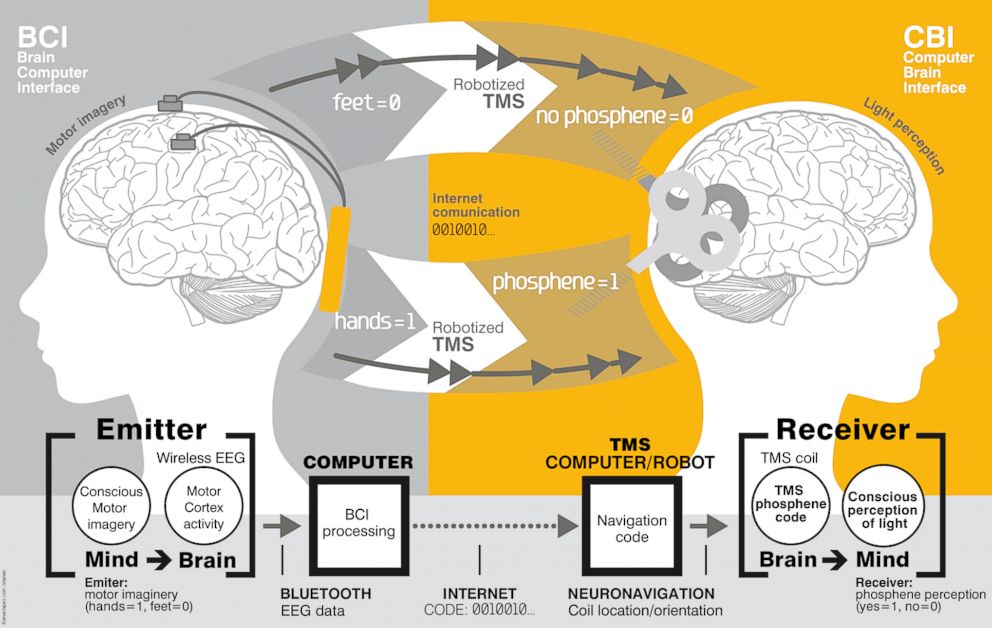
Simply transmitting two words required both the "emitter" and the
"receiver" to be hooked up to robots and sophisticated hardware that
makes the participants look more like captives in a psycho ward than
casual greeters. And the feat required the conscious cooperation of both
participants, who had to be trained for the task.
An electroencephalogram captured the brain activity of the emitter in
India, and converted the letters of the two words to binary code, which
was sent to a nearby computer and then over the Internet to the receiver
in France.
Transcranial magnetic stimulation (TMS) on the receiver's end enhanced
the electrical signals in a key part of the brain, making the receiver
aware that a message would be coming through.
"TMS was basically a way to inject the information into the receiver's brain," Pascual-Leone said.


No comments:
Post a Comment